Objectives of the monitoring
The main high-altitude springs on the sunny slopes of the Maurienne Valley give rise to tributary streams of the Arc River, which have a markedly torrential character: their steep gradients are in some cases harnessed by dams and small hydroelectric power plants. These streams have a snow-fed regime, meaning that their flow reaches a peak in spring, when the snow accumulated at higher elevations in former glacial cirques—their main source of water supply—melts.
The flowing water visible in a stream is only the apparent part of a system of interactions and exchanges between the surface and the subsurface: water may infiltrate into the ground during its course, or conversely the stream may drain groundwater. TELT carries out hydrometric measurements to characterise the hydrogeological functioning of these streams and, where appropriate, detect any changes that, in addition to the surface human developments mentioned above, could influence their flow rates.
The key indicator
Percentage of gains/losses
When the flow rate of a watercourse and its tributaries is measured at two points separated by a certain distance, a variation in flow will be observed between the upstream point(s) and the downstream point. These flow variations are referred to as gains—in the case of a positive variation, meaning there is more water downstream than upstream—or losses—in the case of a negative variation. These measurements make it possible to identify groundwater inflow zones that contribute to feeding watercourses and loss zones where surface water infiltrates into the ground. This indicator therefore helps to detect potential changes in underground flows affecting the watercourse. Gain and loss phenomena may vary according to the season; therefore, the analysis takes into account the period during which monitoring campaigns are carried out.
Partners
The consultancy firm commissioned by TELT and its specialised subcontractor: Géotec and STE
Characteristics of the monitoring
Water levels
Flow rates Percentage of gains/losses
Hydrological monitoring is based on a combination of water-level measurements using staff gauges, which provide a relatively continuous record of flow variations, and tracer studies carried out to identify zones of groundwater inflow and infiltration.
Discover…
Flow measurement techniques using colourimetric or chemical gauging
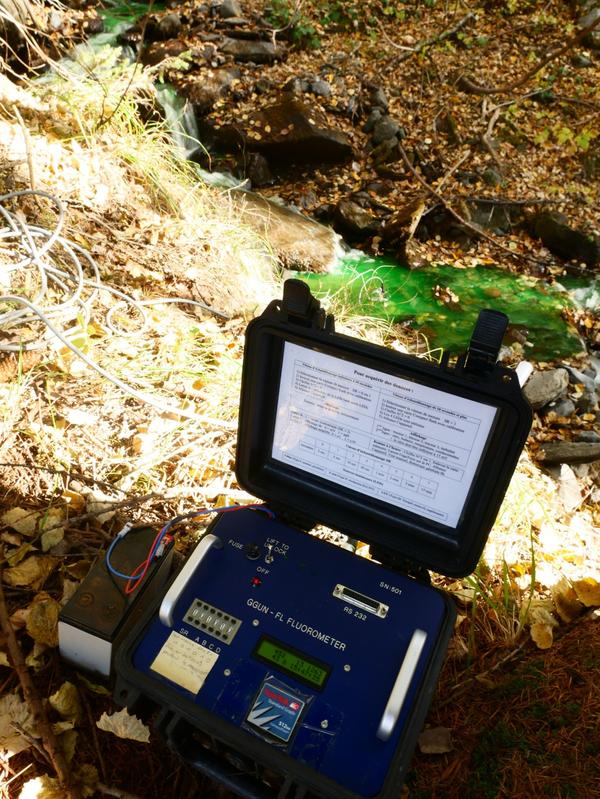
Measuring the flow rate of a watercourse is not always straightforward, even for small mountain streams. When the watercourse does not have, at the measurement location, a uniform and geometric cross-section where the wetted area can be measured and where water velocities can be determined using a current meter and then used in a mathematical formula to calculate discharge, other techniques must be employed, such as so-called “chemical” gauging. The principle involves injecting a tracer upstream of the measurement point. There is nothing harmful to the watercourse in this process, as the tracer is simply a small quantity of salt water. The concentration is then monitored a few dozen metres downstream from the injection point, allowing sufficient mixing with the stream water, through a simple conductivity measurement. Salt releases anions and cations into the water, increasing its conductivity; a laboratory calibration curve is established beforehand to relate conductivity to salt concentration according to the dosage used in the injected tracer.
A variation in salt concentration is therefore observed at the measurement point, producing a curve such as the one shown below.
By calculating the integral of this curve and applying the principle of salt mass conservation, while knowing the mass M of salt contained in the injected tracer, the discharge value can be determined.
This type of measurement can also be carried out using a colourimetric tracer, such as fluorescein, which colours the water. Once again, these substances are entirely harmless to the watercourse. In this case, the colour intensity of the water (its transparency) is measured, while the underlying principle remains the same.